
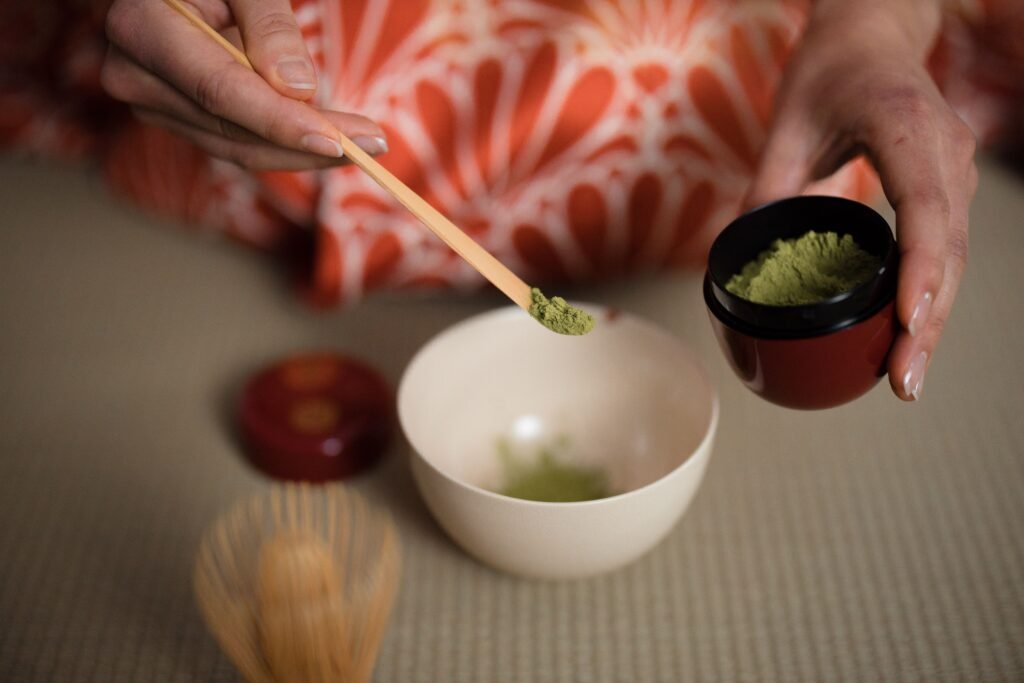
You’ve probably seen the labels: ceremonial grade, culinary grade, premium, latte grade — sometimes all on the same website, with prices ranging from $5 to $80 for what looks like the same green powder. It’s confusing, and it’s supposed to be. The matcha industry has done an excellent job of making simple things sound mysterious.
Here’s the reality: there is no official, government-regulated grading system for matcha. Not in Japan. Not anywhere. The terms you see on packages are marketing labels, not legal classifications. But that doesn’t mean quality differences don’t exist — they absolutely do. The question is how to see through the noise and figure out what you’re actually paying for.
New to matcha basics? Start with our complete guide to what matcha is. Already know your stuff? Here’s everything you need to judge matcha quality like a buyer, not a marketer.
What’s in This Guide
The Short Answer
Matcha is graded on a spectrum based on which leaves were used (harvest), how refined the tencha is, and how finely it was ground — not on some official standard. The terms ceremonial grade and culinary grade are unregulated marketing labels that roughly map to:
- Higher grades = younger leaves, brighter green color, smoother taste, more expensive → best for drinking straight or in lattes
- Lower grades = older/mature leaves, duller green, more bitter/astringent, cheaper → fine for baking, smoothies, cooking
The single most reliable quality indicator that anyone can check? Color. Vivid, bright jade green almost always means better quality. Olive, yellow-brown, or brownish-green means lower grade (or old/stale product). And yes — there are actual scientific instruments that measure this.
The “Ceremonial Grade” Myth
Let’s get this out of the way first because it’s the source of most confusion:
“Ceremonial grade” is not regulated. No Japanese government agency, international standards body, or industry organization controls who can use this term on a package. Any brand, anywhere, can call anything “ceremonial grade matcha.”
This isn’t opinion — it’s verifiable by absence. There is no ISO standard for matcha grades. The Japanese Agricultural Standard (JAS) certifies organic production methods, but does not define or regulate quality tiers. The Japan Tea Central Association publishes no grading definitions. The terms “ceremonial” and “culinary” appear nowhere in Japanese industry regulation — they were coined by Western importers to simplify a quality spectrum for retail consumers.
What this means in practice:
| What marketers want you to believe | Reality |
|---|---|
| “Ceremonial grade” = official certification | Anyone can print it on a label |
| Ceremonial = always better | Only if the actual quality backs it up |
| Culinary = low-quality trash | Culinary-grade from a good producer beats “ceremonial” from a bad one |
| Two neat categories cover everything | Japanese producers use a five-tier system |
So when you see “ceremonial grade” on a $15 tin from Amazon with no origin information, no cultivar name, and no test results? Be skeptical. When you see it from a reputable producer who lists the specific tea field, harvest date, and lab results? That’s different.
The label itself tells you nothing. The information behind the label does.
The Real Grading System
While there’s no official regulation, Japanese matcha producers do use a consistent internal hierarchy. According to OEMJP, which tracks Japanese tea trade data, the conventional pyramid looks like this:
The Five-Tier Matcha Pyramid
| Grade | Leaves Used | Color | Flavor Profile | Best For | Wholesale Price (approx) |
|---|---|---|---|---|---|
| Ceremonial (Point-tea / Koicha) |
First-flush only (ichibancha) Hand-picked youngest tips 20+ days shade |
Brightest vivid emerald | Intensely umami, zero bitterness, velvety texture | Traditional tea ceremony, koicha (thick tea) | $200–500+/kg |
| Premium Ceremonial (Usucha grade) |
First-flush tencha Less strict on cultivar |
Vivid jade green | Sweet, umami-rich, minimal bitterness | Everyday whisked drinking, quality lattes | $60–150/kg |
| Premium Culinary (Latte / Barista grade) |
Early-flush or first-flush Broader leaf selection |
Vibrant green, slightly less bright | Balanced — mild bitterness that pairs with milk | Premium lattes, ice cream, café drinks | $60–150/kg |
| Culinary Grade | Second-flush or blended tencha May include stems/veins |
Duller green, may have yellow tones | Astringent, earthy, noticeably bitter | Baking, general cooking, smoothies | $30–80/kg |
| Ingredient Grade | Heavily processed, industrial | Inconsistent, often dull olive | Flat flavor profile | Mass-market products (chocolate, snacks, supplements) | $15–40/kg |
The key insight: The price ratio between ceremonial-grade tencha and ingredient-grade tencha is roughly 10–20×. That’s not markup — it reflects genuinely different raw materials, processing intensity, and supply scarcity.
Most consumers buying matcha online fall into two buckets: Premium Ceremonial (for drinking) and Culinary (for baking). The true top-tier ceremonial (koicha grade) is rare outside specialty tea shops in Japan, and ingredient grade is what ends up in cheap mass-market products.
Color: The Most Honest Quality Indicator
If you only check one thing before buying matcha, make it color. And I don’t mean “looks green” — I mean measurable, quantifiable green.
Professional matcha buyers use instruments called chromameters that measure color in the L*a*b* color space:
- L* = lightness (0 = black, 100 = white)
- a* = green-red axis (more negative = greener)
- b* = blue-yellow axis
According to First-Agri.jp, a Japanese agricultural technology firm, here’s what each grade should measure:
| Grade | L* Value | a* Value | b* Value | What This Looks Like |
|---|---|---|---|---|
| Ceremonial | 45–55 | -6 to -8 | 15–25 | Bright, luminous jewel-toned green |
| Premium | 40–50 | -4 to -7 | 20–30 | Vivid jade green |
| Culinary | 35–45 | -2 to -5 | 25–35 | Muted green, less vibrant |
| Industrial | 30–40 | 0 to -3 | 30–40 | Dull, olive-yellowish |
The quick visual test: Open the tin near natural daylight. Hold a small amount between your fingers. Genuine high-grade matcha should look like finely milled jade. If it looks khaki, olive drab, or yellow-green, it’s either lower grade or past its prime.
What Actual Lab Tests Show
GreenestMatcha conducted independent chromameter testing of 30+ matcha brands, measuring both color and price-per-gram. The findings were revealing:
- Ippodo (Kyoto) consistently showed the deepest green (a* = -17 to -18) at ~$2/g — premium pricing backed by premium metrics
- Costco/Sencha Naturals “Everyday Matcha”: a* = -7.6 at $0.13/g — visibly less green, but honest about being entry-level
- Some “ceremonial grade” mid-range brands: a* = -13 to -15 at $0.50–$1/g — decent middle ground
- Starbucks store matcha: a* = -12.1 — surprisingly decent color for mass-market café use
The pattern holds up across the board: you generally get what you pay for, but the relationship isn’t perfectly linear. Some mid-priced brands punch above their weight, while some overpriced “luxury” tins underperform.
Why does shade-growing produce this distinctive color? Research from the University of Tsukuba on the Yabukita cultivar found that shaded tea leaves produce significantly higher chlorophyll content, which directly translates to deeper negative-a* (greener) values in the final powder. The shading doesn’t just change the plant’s chemistry — it literally changes the color.
Cultivars Matter More Than You Think
Just as wine varies by grape variety, matcha varies by tea cultivar (the specific variety of Camellia sinensis plant). High-quality producers will tell you which cultivar(s) their matcha comes from. If they don’t, that’s a transparency red flag.
The four main cultivars used for premium matcha:
| Cultivar | Flavor Profile | Characteristics | Best For |
|---|---|---|---|
| Yabukita (やぶきた) | Balanced, clean, slightly vegetal | The most widely grown tea cultivar in Japan (~75% of tea fields). Reliable yield, adaptable. Good baseline quality. | Everyday drinking, lattes, good all-rounder |
| Okumidori (おくみどり) | Rich umami, deep, harmonious | Buds ~1 week later than Yabukita. Exceptional umami with minimal astringency. Beautiful bright green color. | Premium ceremonial drinking, traditional preparation |
| Saemidori (さえみどり) | Naturally sweet, exceptionally smooth | Cross between Asatsuyu and Yabukita. Called “natural sweetener” — very low bitterness even for new drinkers. | Beginners, people sensitive to bitterness, dessert pairing |
| Tsuyuhikari (つゆひかり) | Elegant floral notes, delicate aroma | Rare, grown primarily in Yame (Fukuoka). Complex aromatic profile. Limited production. | Connoisseurs, special occasion drinking |
A single tin of matcha might be a blend of multiple cultivars — that’s normal and often intentional, to create a balanced flavor profile. But if a brand won’t tell you anything about what cultivar went into their product, ask why.
Origin: Where Your Matcha Grew
Japan has four primary matcha-producing regions, each with a distinct reputation:
| Region | Prefecture | Known For | Reputation |
|---|---|---|---|
| Uji (宇治) | Kyoto | Historic prestige, centuries-old tea culture, koicha tradition | The gold standard. Highest prices. |
| Nishio (西尾) | Aichi | Large-scale production, organic pioneers, consistent quality | Excellent value. Major supplier to overseas markets. |
| Yame (八女) | Fukuoka | Gyokuro expertise translating to exceptional matcha, Tsuyuhikari cultivar | Rising star. Premium quality, smaller production. |
| Kagoshima (鹿児島) | Kagoshima | Newest major region, larger farms, modern techniques | Good quality at competitive prices. Fastest-growing. |
Does origin guarantee quality? Not by itself. There’s mediocre Uji matcha and excellent Kagoshima matcha. But origin gives you context about growing conditions, farming traditions, and traceability expectations. “Product of Japan” without specifying the region is less useful than “Uji, Kyoto, harvested April 2025.”
Non-Japanese matcha (primarily from China) exists and can be perfectly safe for culinary use. But for drinking-grade matcha, Japanese-grown remains the benchmark for flavor consistency and safety testing standards.
Price Guide: What’s Fair?
Here’s a rough guide to retail pricing (what you’d actually pay, not wholesale):
| Grade / Quality Level | Price per 30g Tin | Price per 100g | Who It’s For |
|---|---|---|---|
| Entry-level culinary | $5–12 | $12–25 | Baking experiments, smoothies |
| Mid-range culinary | $12–22 | $30–50 | Regular bakers, cooking enthusiasts |
| Decent drinking matcha | $18–35 | $45–85 | Daily latte drinkers |
| Premium ceremonial | $30–55 | $90–180 | Serious drinkers, gift-worthy |
| Top-tier (koicha-grade) | $55–100+ | $180–350+ | Tea ceremony practitioners, connoisseurs |
Red flag: A “ceremonial grade” 30g tin for under $15 shipped from an unknown brand. At that price point, either the margins are impossibly thin (suggesting cut corners somewhere) or it’s mislabeled culinary grade. Neither scenario is great.
Safety: Heavy Metals and Lab Testing
Because you consume the entire leaf with matcha, any contaminants present in the leaf end up in your body. With regular steeped tea, heavy metals largely stay behind in the discarded leaves. With matcha, there’s no filter. This makes safety testing particularly important.
What ConsumerLab Found
ConsumerLab tested 21 green tea products in 2024, including several matcha powders. Key takeaways:
- Lead and arsenic: Present in trace amounts in some products. For steeped teas, these metals stay mostly in the leaves (not extracted into water). For matcha powders, you consume whatever is present.
- Japanese-sourced matcha: Among the six matcha brands specifically tested by ConsumerLab over multiple years, premium Japanese brands consistently showed minimal to undetectable levels of lead and other heavy metals.
- Non-Japanese sources: Higher variability. Some Chinese-produced matcha showed elevated levels (ConsumerLab noted Chinese matcha can contain up to 30× the lead of Japanese matcha).
- Pesticides: All tested premium Japanese brands passed pesticide residue tests.
Practical advice: If you drink matcha daily (especially pregnant or nursing), choose a brand that provides third-party lab test results (from labs like Eurofins, SGS, or ConsumerLab). Look for certificates of analysis (COAs) that specifically list heavy metal limits. Organic certification helps with pesticides but does NOT automatically guarantee heavy-metal-free status.
The 2024–2025 Supply Crisis
If matcha seems more expensive lately, it’s not just inflation. The industry is experiencing an actual supply crisis.
Reuters, reporting via The Straits Times, confirmed the supply crisis using MAFF data and on-the-ground farmer interviews:
- Uji hand-picked tencha production dropped 40% year-over-year (10,216 kg → 6,140 kg)
- Machine-harvested first-flush tencha fell 18% (529,960 kg → 434,521 kg)
- Kyoto auction prices climbed 170% since 2016 (¥4,862/kg → ¥8,235/kg in May 2025)
CCTV (China Central Television) independently confirmed the auction price spike, reporting that Kyoto tencha hit ¥8,235/kg in May 2025 — a 170% increase year-over-year.
Why This Is Happening
- Climate change: Record heatwaves in summer 2024 damaged tea bushes across Kyoto, reducing yields and quality
- Aging farmers: The number of tea cultivators dropped from 54,000 (2000) to ~20,000 (2025) in some prefectures
- Explosive global demand: Driven by social media (“MatchaTok”), exports rose 16% by volume and 25% by value in 2024
- Production can’t scale quickly: New tea bushes take 3–5 years to reach full production
Leading Kyoto tea houses including Ippodo and Marukyu Koyamaen have imposed purchase caps on consumers to preserve stock for long-standing clients. Retail matcha prices have doubled in some overseas markets.
What this means for you: Expect continued upward pressure on prices, especially for ceremonial-grade matcha. Premium culinary grade (latte grade) is becoming the pragmatic choice for many buyers — enough quality for excellent beverages, with better supply availability.
How to Choose: A Framework
Forget the grade labels for a moment. Here’s a practical decision framework based on what you actually want to do:
🍵 If You Want to Drink Matcha Straight (Traditional Style)
- Look for: Origin specified (Uji/Nishio/Yame/Kagoshima), cultivar named, harvest date within last 12 months, bright jade green color, third-party lab test available
- Budget range: $25–55 per 30g
- Test: Whisk 1.5g in 70ml water at 70°C. Should taste smooth, slightly sweet, umami-rich. No harsh bitterness.
- Red flags: No origin listed, brownish/yellowish powder, tastes aggressively bitter or grassy, priced under $15 for 30g
🥛 If You Want Matcha Lattes (Daily Driver)
- Look for: Vibrant green color, “latte grade” or “premium culinary” labeling from a reputable source, good reviews for mixing with milk
- Budget range: $15–30 per 30g (or buy 100g tins for better per-gram value)
- Test: Mix into warm milk. The flavor should come through clearly without being overwhelmed. Color should remain distinctly green, not murky brown-green.
🍪 If You Want to Bake With Matcha
- Look for: “Culinary grade” from a known producer, darker green is fine (the color gets baked anyway), reasonable price point
- Budget range: $10–22 per 100g
- Note: Don’t waste ceremonial-grade money on brownies. The baking process obliterates the subtle flavor differences you’re paying extra for.
Frequently Asked Questions
Is “ceremonial grade” actually a real thing?
It describes a real category of high-quality matcha, but the term itself is not regulated. Any company can put “ceremonial grade” on any product. Judge by the actual specifications (origin, cultivar, color, taste), not the label. Think of it like “artisanal” on food packaging — sometimes accurate, sometimes marketing fluff.
Can I use ceremonial grade matcha for baking?
Technically yes, but it’s a waste of money. Ceremonial-grade costs 10–20× more than culinary-grade because of its delicate flavor profile, which gets obliterated by sugar, butter, flour, and oven heat. Save ceremonial for drinking. Use culinary for cookies.
Does matcha expire? How long does it last?
Matcha degrades through oxidation. Unopened and stored properly (cool, dark, airtight), it stays fresh for 12–18 months. Once opened, use within 6–8 weeks for best flavor. Signs of staleness: dull olive/brown color instead of bright green, flat smell, hay-like or dusty taste.
Is organic matcha worth the extra cost?
Organic certification (JAS, USDA NOP, EU Organic) guarantees reduced pesticide use. However, organic does not automatically mean heavy-metal-free. Japan’s conventional tea agriculture already uses relatively strict pesticide regulations. For most consumers, choosing a reputable Japanese producer matters more than the organic seal alone. If pesticide residue is a top concern, organic is worth the premium.
Why is some matcha $5 and some $80 for the same amount?
The difference comes down to: (1) Harvest — first-flush vs. later harvests, (2) Leaf selection — youngest tips only vs. broader leaves, (3) Processing — traditional stone-milling vs. industrial grinding, (4) Origin and traceability, (5) Supply chain length. A $5 “ceremonial” tin is likely mislabeled culinary or stale inventory. An $80 tin is probably genuine koicha-grade from a heritage producer. Both exist. The $20–35 range is where most daily drinkers find their sweet spot.
Is Chinese matcha safe?
For culinary use (baking, cooking), Chinese matcha can be fine and significantly cheaper. For daily drinking, Japanese-sourced matcha has a stronger track record for consistency and safety testing. ConsumerLab has found higher variability in heavy metal levels among non-Japanese sources. If you do buy Chinese matcha for drinking, insist on lab test documentation.
How much matcha should I buy at once?
Buy only what you’ll use in 6–8 weeks once opened. A 30g tin is roughly 15–20 servings (1.5–2g per serving). If you drink daily, that’s about 2–3 weeks. Buying large tins (100g+) only makes sense if you go through matcha quickly or store unopened portions properly. Once oxygen hits the powder, the countdown starts.
Will matcha prices come back down?
Not anytime soon. The 2024–2025 supply crisis is structural — climate change, farmer aging, and demand growth aren’t temporary blips. New tea bushes planted today won’t reach full production for 3–5 years. Experts expect tight supplies through late 2025, with possible recovery by the 2026 harvest if climate cooperates. Prices may stabilize but unlikely to return to pre-crisis levels.
The Bottom Line
Matcha Buying Cheat Sheet
- Color — bright jade green = good; khaki/olive/yellow = bad
- Origin — specific region (Uji/Nishio/Yame/Kagoshima) > just “Japan”
- Cultivar — named cultivar = transparency; no cultivar = red flag
- Harvest date — within last 12 months for best quality
- Lab tests — third-party heavy metal testing if you drink daily
- Drink straight → Premium ceremonial ($25–55/30g)
- Lattes daily → Premium culinary / latte grade ($15–30/30g)
- Baking & cooking → Culinary grade ($10–22/100g)
- Tea ceremony → Top-tier koicha grade ($55–100+/30g)
- The “ceremonial grade” label alone — it’s unregulated marketing
- Any “ceremonial” tin under $15 with no origin or cultivar info
- Grade labels in general — focus on the actual specs behind them
- Buying in bulk if you can’t finish it in 6–8 weeks — freshness beats hoarding